
1 страниц (9 вхождений)
Unit Conversion - Unit conversion problem - Сообщения

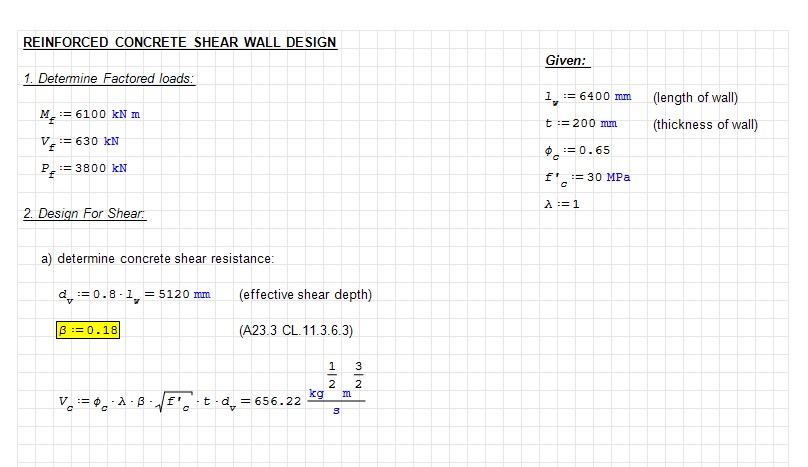
I am trying to convert the Vc value to kN (kilonewtons) in SMath. However, the program is not allowing the conversion, and the resulting units appear unusual (kg^1/2·m^3/2/s). Could you please help me identify the issue and explain how to correct the formula so the result can be expressed in kN?
1 пользователям понравился этот пост
Vidar Gundersen 15.03.2026 12:18:02
Looks like your equation is an empirical formula.
Usually these type of formulas need unit elimination.
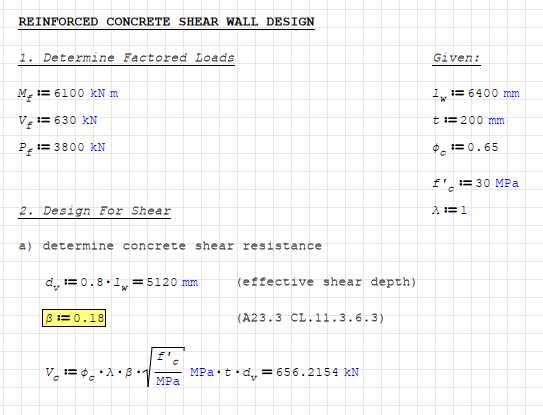
Try to change your equation as below.
Regards
Usually these type of formulas need unit elimination.
Try to change your equation as below.
Regards
2 пользователям понравился этот пост
In physical equations, variables represent value and unit.
In empirical or numerical value equations, variables represent just the numerical values. These equations are not self contained but rather require specification as to what units the numerical vaIues refer.
In design codes, this specification is typically centralized, i.e., for a given quantity the unit is always the same throughout the code.
Users tend to forget about that.
Using a numerical value equation with physical quantity variables requires dividing all quantities by the unit in which their values are expected in the equation.
The result in SMath then is a pure numerical value (should be unitless). The unit this value referst to is again matter of convention in the design code. If you want to store the result in a physical value variable, then you have to multiply the equation with the corresponding unit.
To emphasise that a particular variable stores just the numerical value, you can use a subscript referring to the unit.
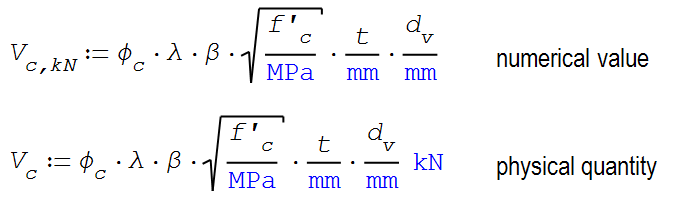
The example below is only correct, if the numerical value equation actually is meant to return the value in kN.
In empirical or numerical value equations, variables represent just the numerical values. These equations are not self contained but rather require specification as to what units the numerical vaIues refer.
In design codes, this specification is typically centralized, i.e., for a given quantity the unit is always the same throughout the code.
Users tend to forget about that.
Using a numerical value equation with physical quantity variables requires dividing all quantities by the unit in which their values are expected in the equation.
The result in SMath then is a pure numerical value (should be unitless). The unit this value referst to is again matter of convention in the design code. If you want to store the result in a physical value variable, then you have to multiply the equation with the corresponding unit.
To emphasise that a particular variable stores just the numerical value, you can use a subscript referring to the unit.
The example below is only correct, if the numerical value equation actually is meant to return the value in kN.
Отредактировано 10.03.2026 11:51:04
Technische Mechanik mit SMath Studio: https://link.springer.com/book/10.1007/978-3-658-50592-9
1 пользователям понравился этот пост
Tarang 10.03.2026 13:03:33
When working with design codes or other industrial standards, numerical value variables and corresponding formulas are used. This concept works perfectly with non-unit-aware software. If you try to use tools like Mathcad and SMath, then frustration is guaranteed if you don't have a clear understanding of the difference between the concepts of numerical value variables and physical property variables. You can apply both in SMath worksheets.
Numerical value variables:
- any variable is defined as pure numerical value.
- Values given in other than the standard's units must be converted beforehand. This can be done using SMath's unit conversion mechanism.
- Units can be supplied as descriptions (this allows for lookup of the unit in the dynamic assistant)
- the numerical value formulas from the standard can be used directly. The resulting unit is not result of the calculation but is given by the standard and can again be recorded in the description.
- in physical quantity formulas, the numerical value variables have to be multiplied by the units they refer to. If the result has to be a numerical value, the expression must be divided by the corresponding unit.
- Display of variables will just give the numerical value. Unit information must be annotated as text (possibly generated from the description)
- All numerical methods (in particular, the solvers) are directly applicable
Physical quantity variables:
- any variable is defined as product of numerical value and unit (the unit possibly being 1 or some numerical value, for dimensionless variables).
- In numerical value formulas, any variable has to be divided by the unit expected in the standard and the complete expression is multiplied by the unit as specified in the standard. This may appear ugly and bloated.
- physical quantity formulas can be used directly.
- Display of variables will always come with a unit selected by SMath. This unit can be changed manually and the numerical value will be adjusted automatically.
- Numerical methods like solvers require at times awkward unit suppression and regaining tricks.
I'll add an example later.
Numerical value variables:
- any variable is defined as pure numerical value.
- Values given in other than the standard's units must be converted beforehand. This can be done using SMath's unit conversion mechanism.
- Units can be supplied as descriptions (this allows for lookup of the unit in the dynamic assistant)
- the numerical value formulas from the standard can be used directly. The resulting unit is not result of the calculation but is given by the standard and can again be recorded in the description.
- in physical quantity formulas, the numerical value variables have to be multiplied by the units they refer to. If the result has to be a numerical value, the expression must be divided by the corresponding unit.
- Display of variables will just give the numerical value. Unit information must be annotated as text (possibly generated from the description)
- All numerical methods (in particular, the solvers) are directly applicable
Physical quantity variables:
- any variable is defined as product of numerical value and unit (the unit possibly being 1 or some numerical value, for dimensionless variables).
- In numerical value formulas, any variable has to be divided by the unit expected in the standard and the complete expression is multiplied by the unit as specified in the standard. This may appear ugly and bloated.
- physical quantity formulas can be used directly.
- Display of variables will always come with a unit selected by SMath. This unit can be changed manually and the numerical value will be adjusted automatically.
- Numerical methods like solvers require at times awkward unit suppression and regaining tricks.
I'll add an example later.
Отредактировано 15.03.2026 12:33:08
Technische Mechanik mit SMath Studio: https://link.springer.com/book/10.1007/978-3-658-50592-9

Even if it might seem that the "physical quantity" approach initially makes the formula "less clean" or more frustrating to use, it has the significant advantage of documenting clearly the expected units. This is often overlooked in many documents. For instance, in geotechnical engineering, there are numerous empirical formulations that are frequently adapted for different units (e.g., kgf, kPa, psi), and sometimes these are mixed when incorporating formulations from various authors, often without clear explanations of the correct expected units.
Отредактировано 13.03.2026 11:53:53
If you like my plugins please consider to support the program buying a license; for personal contributions to me: paypal.me/dcprojects
Davide, I totally agree.
Once you are compiling mathematical models without strict reference to a single standard or code, the physical quantity approach is preferrable and enforces clarity about the units.
Once you are compiling mathematical models without strict reference to a single standard or code, the physical quantity approach is preferrable and enforces clarity about the units.
Technische Mechanik mit SMath Studio: https://link.springer.com/book/10.1007/978-3-658-50592-9
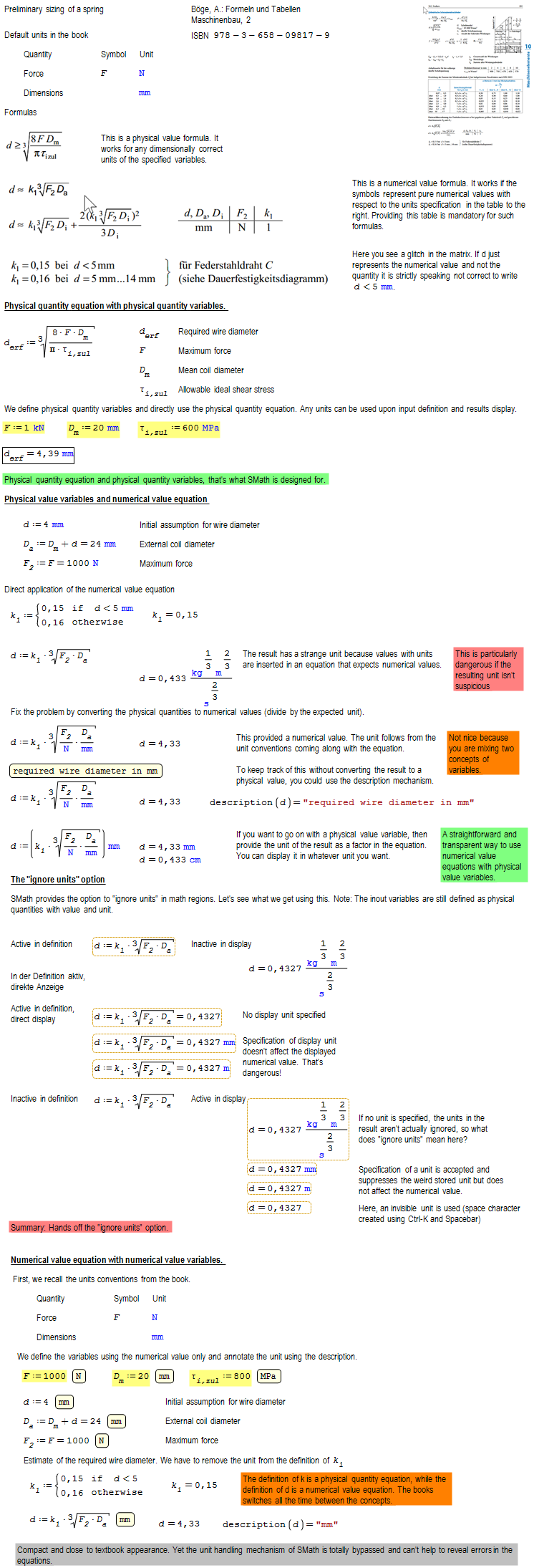
Here is an example based on a textbook. The book is a real challenge for SMath users, because it switches all the time between physical quantity equations and numerical value equation.
This illustrates that it is not straightforward to implement formulas from textbooks. You even have to modifiy them at time if you follow a strict numerical value approach.
So it is essential for any SMath user to really understand this. Otherwise things can get dangerous.
Sorry for the big image. I don't see how to wrap it in spoiler tags. Admins, feel free to fix this.
Größengleichungen.sm (197,83 КиБ) скачан 622 раз(а).
This illustrates that it is not straightforward to implement formulas from textbooks. You even have to modifiy them at time if you follow a strict numerical value approach.
So it is essential for any SMath user to really understand this. Otherwise things can get dangerous.
Sorry for the big image. I don't see how to wrap it in spoiler tags. Admins, feel free to fix this.
Größengleichungen.sm (197,83 КиБ) скачан 622 раз(а).
Technische Mechanik mit SMath Studio: https://link.springer.com/book/10.1007/978-3-658-50592-9
2 пользователям понравился этот пост
Hi. This is another way. This formalism can be applied as long as the units are not Interval Scales (Temperature) or Logarithmic Level Scales (Decibels). If the definition of the quantity involves a sum, a 'Ud1, 'Ud2, ... can be used for each term.
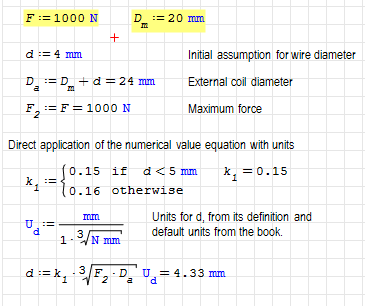
Units for empirical formulas.sm (8,73 КиБ) скачан 598 раз(а).
Best regards.
Alvaro.
Units for empirical formulas.sm (8,73 КиБ) скачан 598 раз(а).
Best regards.
Alvaro.
1 пользователям понравился этот пост
Davide Carpi 16.03.2026 16:26:25
Hi Alvaro, this is a nice version, Yet I'd still recommend to divide the physical quantity variables by the corresponding units, because I think that is easier to verify.
Technische Mechanik mit SMath Studio: https://link.springer.com/book/10.1007/978-3-658-50592-9
1 страниц (9 вхождений)
- Новые сообщения
- Нет новых сообщений