
1 страниц (13 вхождений)
Find the formula for the volume of a solid - Сообщения

Consider a solid bounded by a surface formed by the intersection of seven cylinders of radius $R$. The axes of these cylinders all intersect at a single point; four of the axes are directed along the long diagonals of a cube, while the remaining three are perpendicular to the faces of the cube
Look at the image.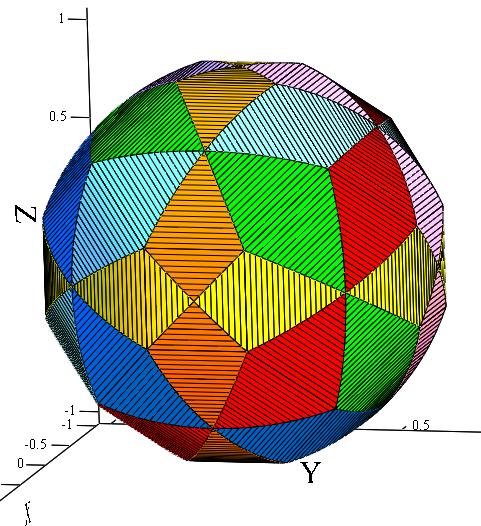
Look at the image.
Hi. Maybe something like this
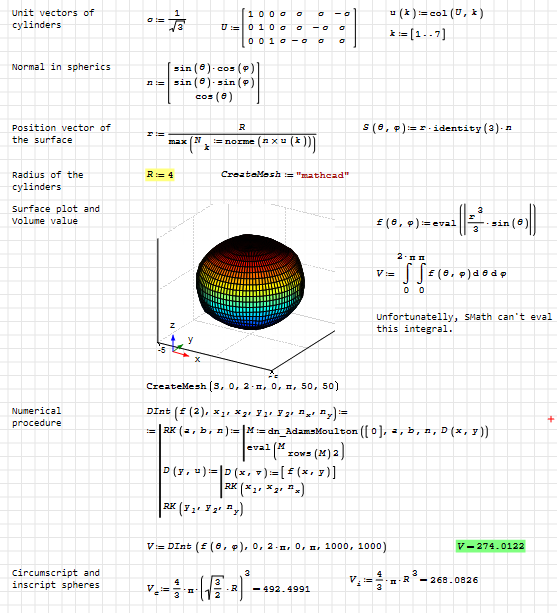
VolumeOfIntersection.sm (17,39 КиБ) скачан 50 раз(а).
VolumeOfIntersection.pdf (442,78 КиБ) скачан 56 раз(а).
Best regards
Alvao
VolumeOfIntersection.sm (17,39 КиБ) скачан 50 раз(а).
VolumeOfIntersection.pdf (442,78 КиБ) скачан 56 раз(а).
Best regards
Alvao
2 пользователям понравился этот пост
Alvaro, thank you. Unfortunately, your calculation method results in a 4.5 percent error relative to the true volume of the object.
(The layer thickness turned out to be a bit too small.
(The layer thickness turned out to be a bit too small.
Alvaro, the discussion concerned obtaining an exact formula. Look up "Steinmetz solid" on Wikipedia. Your approximate formula does not account for the volume of the parts cut off from the solid.
See the image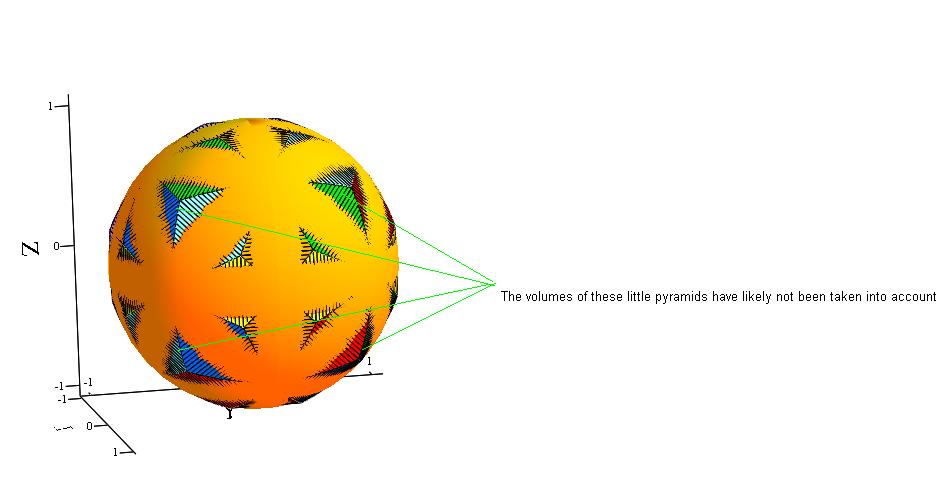
See the image
Hi Victor. The procedure looks good enough to me for the others cases.
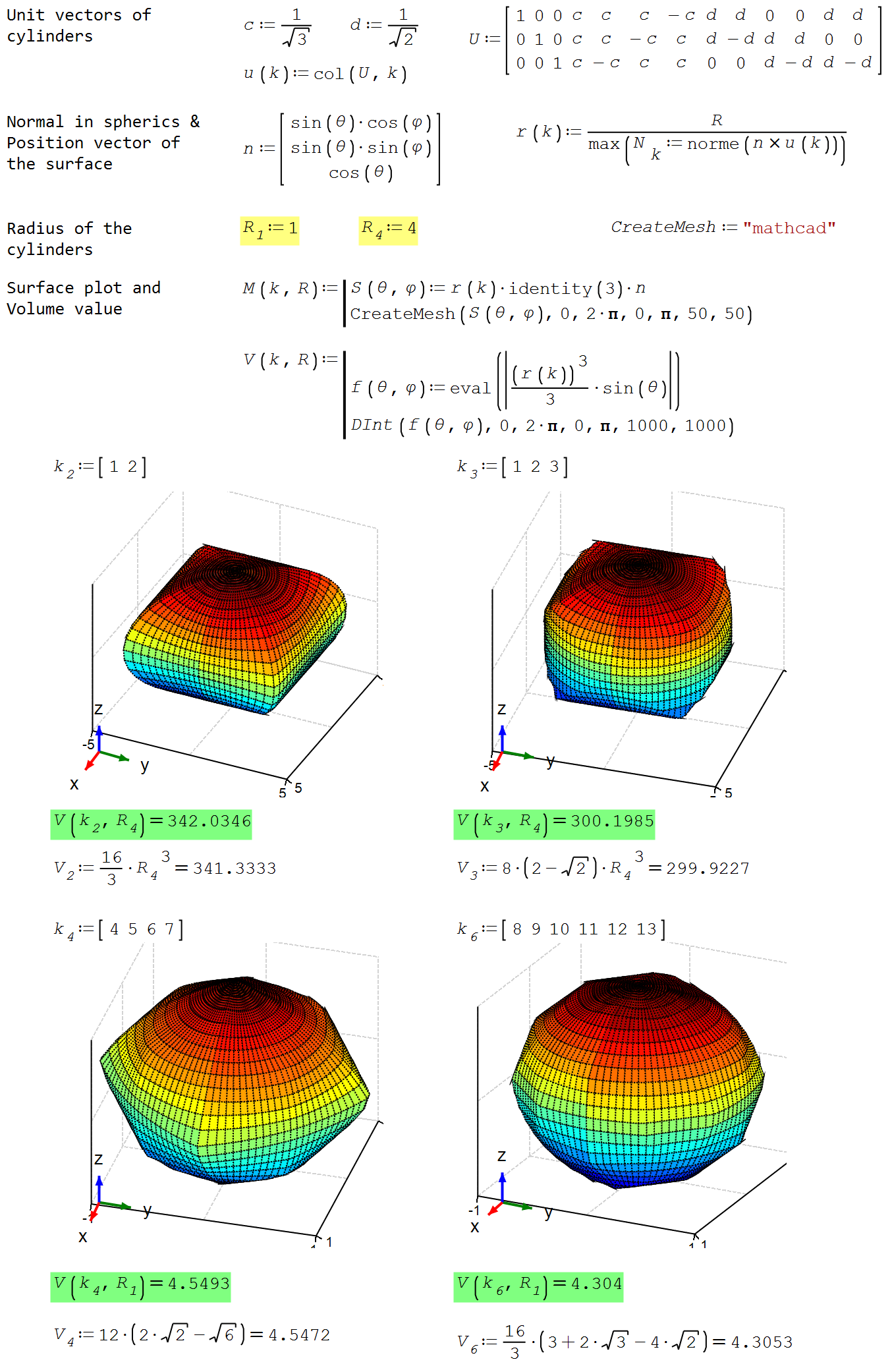
Steinmetz Solid.pdf (2,79 МиБ) скачан 47 раз(а).
Steinmetz Solid.sm (25,39 КиБ) скачан 48 раз(а).
Best regards
Alvaro.
Steinmetz Solid.pdf (2,79 МиБ) скачан 47 раз(а).
Steinmetz Solid.sm (25,39 КиБ) скачан 48 раз(а).
Best regards
Alvaro.
1 пользователям понравился этот пост
Victor 23.10.2026 13:53:58
It might be a bit difficult to spot the pyramids, as they are small, but if you look carefully, they are there. And given that the same method yields acceptable results for the other cases, I believe the procedure is sufficiently validated. What value do you get for the volume in this case? I consider 274.0 to be a good approximation, especially considering that the numerical procedure used for the double integral is quite concise—it takes up only a few lines of code.
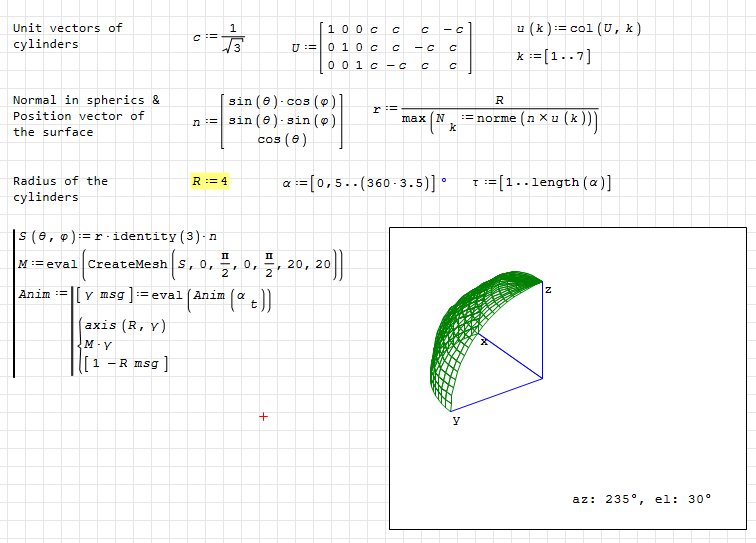
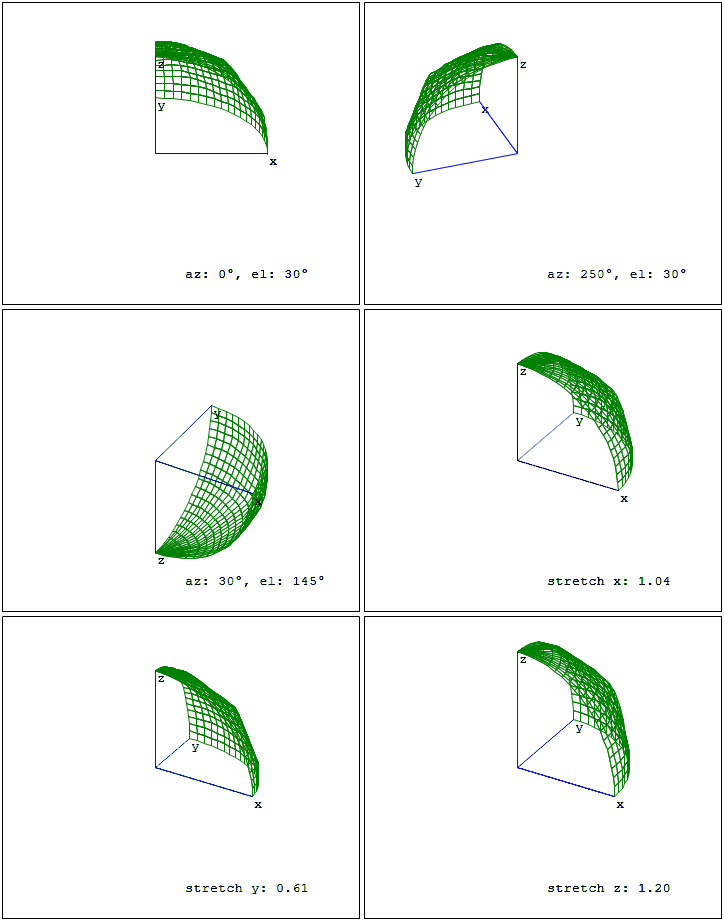
Steinmetz Solid Anim.sm (23,1 КиБ) скачан 47 раз(а).
Best regards
Alvaro.
Steinmetz Solid Anim.sm (23,1 КиБ) скачан 47 раз(а).
Best regards
Alvaro.
1 пользователям понравился этот пост
Victor 23.10.2026 13:54:18
Alvaro, if you’ve noticed, the exact formulas do not contain the number pi, whereas yours does.
Why does your formula yield the greatest margin of error in the case of the intersection of two cylinders? Also, I’ve begun to doubt the accuracy of my own "exact" formula for seven cylinders, as it results in an error of 4.5 percent—which is quite large
Why does your formula yield the greatest margin of error in the case of the intersection of two cylinders? Also, I’ve begun to doubt the accuracy of my own "exact" formula for seven cylinders, as it results in an error of 4.5 percent—which is quite large
Отредактировано 18.10.2026 16:29:46
WroteAlvaro, if you’ve noticed, the exact formulas do not contain the number pi, whereas yours does. ...
Because it is not an explicit formula for each individual case, but rather a general formula, involving a double integral, that applies to all cases. Pi appears in the limits of integration.
Wrote... Why does your formula yield the greatest margin of error in the case of the intersection of two cylinders? ...
Because my method for calculating the double integral is extremely concise, it is not expected to yield a high degree of approximation. Regardless, I am very proud of it; I don’t see it implemented very often. In fact, I have never encountered it in any book. If you happen to find a reference to this method, I would welcome it.
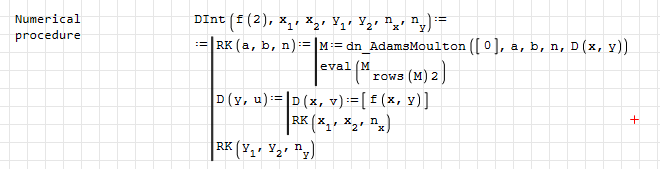
Better precision can be achieved by utilizing some of the symmetries present in the surfaces and increasing the number of points.
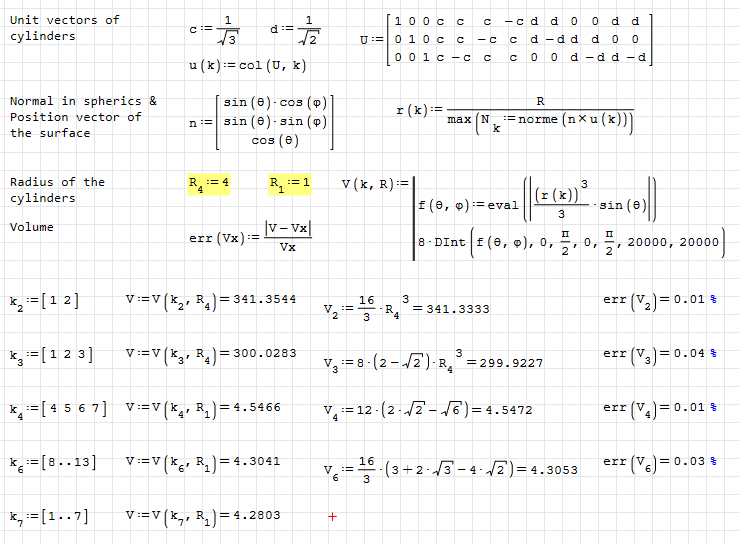
Finally, the same procedure can also be implemented in Maple. This is the code, which uses the legacy `linalg` library and was executed in Maple 11. I was unable to copy and paste the code into a Maple component within SMath. These results are even more accurate.
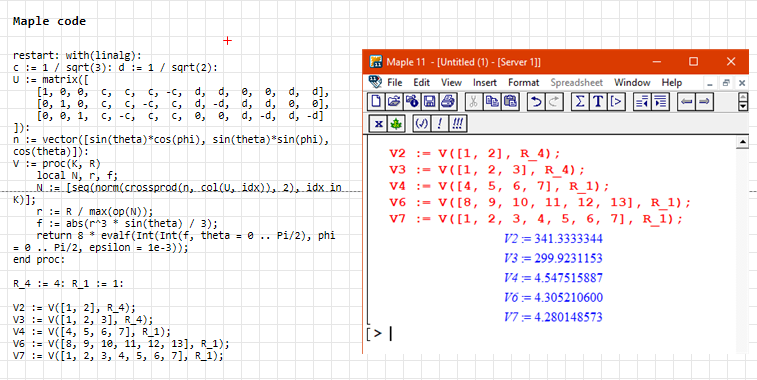
Steinmetz Solid Volume.sm (48,27 КиБ) скачан 32 раз(а).
Steinmetz Solid Volume.pdf (475,06 КиБ) скачан 34 раз(а).
Best regards.
Alvaro.
1 пользователям понравился этот пост
Victor 23.10.2026 13:54:48
Alvaro, the translator translated the text incorrectly, so I deleted the message
Отредактировано 20.10.2026 09:11:13
Hello, Alvaro. I have finally verified my exact formula.
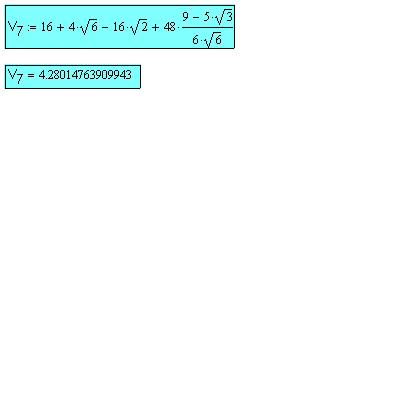
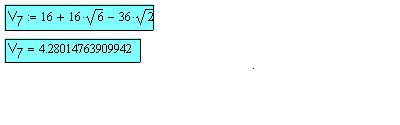
It consists of two parts. The first part remains unchanged, while the second part had to be recalculated. The second part is also exact, but it appears quite cumbersome (neither Mathcad nor I have been able to simplify it). The volume of the solid (V7), calculated to 14 decimal places, is 4.28014763909942...
Perhaps the reason these exact formulas—for cases involving seven or more cylinders—are not included on Wikipedia is precisely because of their complexity.
Your calculations differ from the exact values only starting at the fourth decimal place. Thank you once again for responding to this topic; without your input, I wouldn't have bothered to refine the formula.
Отредактировано 21.10.2026 18:45:34
Alvaro, the formula turned out quite long, but it is what it is.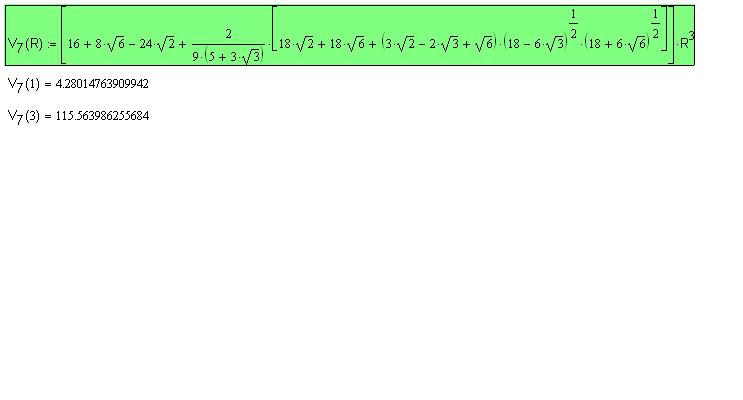
Отредактировано 22.10.2026 18:14:52
1 страниц (13 вхождений)
- Новые сообщения
- Нет новых сообщений