
1页(8条)
Missing bracket in display of complex numbers with changed units - BTS Issue SS-27 - 消息

Technische Mechanik mit SMath Studio: https://link.springer.com/book/10.1007/978-3-658-50592-9

I do not know if this missing brackets is connected to the behavior already mentioned many times by me. It still remained unsolved. Look at video please. Again, the brackets are missing in the display.
Brackets problem and range()
By looking at the actual commands, I do not know if there is something that could be done
c: range(1,10)*'m
g: (range(1,10))*'m
In the case of comple numbers, the brackets just disappear when inserting another unit
Brackets disappear in complex
z: (5+6*i)*'m
z=(5+6*i)*'m
z=500+600*i@'cm
z=500+600*i@'cm
Regards,
Radovan
When Sisyphus climbed to the top of a hill, they said: "Wrong boulder!"
1位用户喜欢此帖子
Martin Kraska 2013/6/26 05:53:00
Symbolic evaluation seems to work. Although brackets should be kept in all cases.
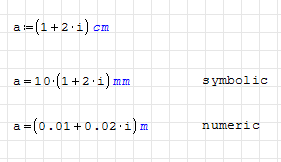
The problem seems to apply to any operator representation of internal functions, if that operator has no bracketing visual structure (i.e. has placeholders without wrapping structure). Internally, complex numbers, ranges, sums and the like, are represented by a function or object which does not require brackets around it.
However, the cartesian representation for complex number is Re + Im i, that is + operation, as well as in sums. In ranges, the internal operator is just side by side putting of numbers, with undefined precedence perhaps somewhere below multiply.
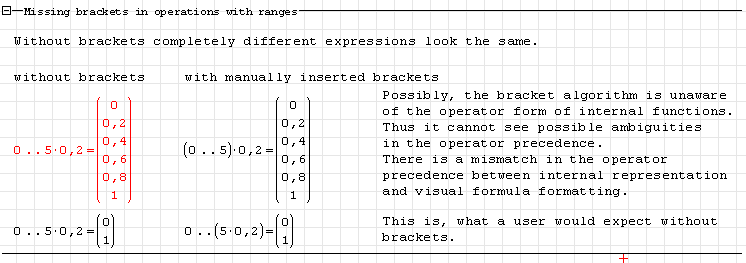
However, the cartesian representation for complex number is Re + Im i, that is + operation, as well as in sums. In ranges, the internal operator is just side by side putting of numbers, with undefined precedence perhaps somewhere below multiply.
Technische Mechanik mit SMath Studio: https://link.springer.com/book/10.1007/978-3-658-50592-9
WroteSymbolic evaluation seems to work.
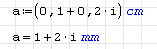
That was just by chance. The problem persists for symbolic optimization as well.
Technische Mechanik mit SMath Studio: https://link.springer.com/book/10.1007/978-3-658-50592-9

Mhhh.. I don't understand what is the problem about units and imaginary numbers... 
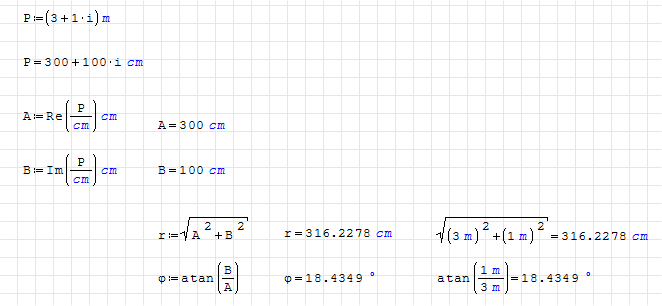
What's the expected result?
What's the expected result?
If you like my plugins please consider to support the program buying a license; for personal contributions to me: paypal.me/dcprojects
The problem is that the visual representation suggests that P is a sum of dimensionless number 300 and dimensioned imaginary 100*I centimeters (i.e. unitless number is added to a length). Surely, this is only a visual artifact, and internally the program keeps record that the unit (cm) is applied to the whole number (300+100*i), but this is yet another place where the visual representation is plain wrong.
С уважением,
Михаил Каганский
1位用户喜欢此帖子
Davide Carpi 2013/6/26 08:48:00
WroteThe problem is that the visual representation suggests that P is a sum of dimensionless number 300 and dimensioned imaginary 100*I centimeters (i.e. unitless number is added to a length). Surely, this is only a visual artifact, and internally the program keeps record that the unit (cm) is applied to the whole number (300+100*i), but this is yet another place where the visual representation is plain wrong.
Thank you, now I understand the point

If you like my plugins please consider to support the program buying a license; for personal contributions to me: paypal.me/dcprojects
1页(8条)
- 有新帖
- 无新帖