
1页(9条)
Slow calculation - 消息

Hi all, I am putting together a quick worksheet to calculate factor of safety against soil liquefaction triggering. As I have been going step-by-step and defining the various variables, I noticed that all the calculations take place more or less instantaneously, whereas the last variable I defined (N1_60cs) seems to take a relatively long time to calculate (approximately 12 seconds on my machine). The worksheet I have so far is attached.
Any thoughts as to what is causing this? Thanks in advance!
Seismic Site Class & Liquefaction Potential.sm (124.01 KiB)已下载 1532 次。
Any thoughts as to what is causing this? Thanks in advance!
Seismic Site Class & Liquefaction Potential.sm (124.01 KiB)已下载 1532 次。

Hi,
select all > optimization > numeric
AND EITHER
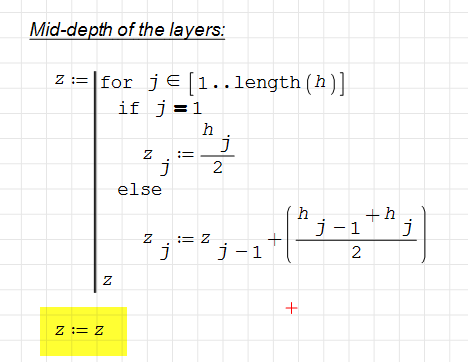
z:z
OR
z:+line(...)
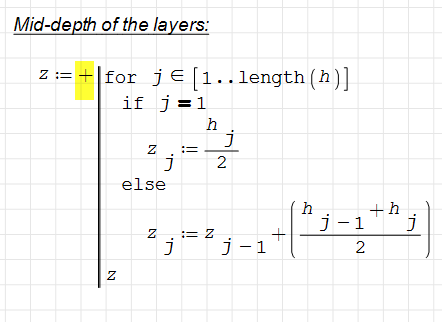
This is because z:line() is a procedure (something like a function, but for variables); it doesn't evaluates in place on definition, hence is completely calculated from scratch every time you need z, z[j], etc....
Using a + between the definition operator and the line() function, you don't have anymore a procedure; using z:z, it evaluates once from that point onwards.
Seismic Site Class & Liquefaction Potential_num.sm (124.85 KiB)已下载 1506 次。
select all > optimization > numeric
AND EITHER
z:z
OR
z:+line(...)
This is because z:line() is a procedure (something like a function, but for variables); it doesn't evaluates in place on definition, hence is completely calculated from scratch every time you need z, z[j], etc....
Using a + between the definition operator and the line() function, you don't have anymore a procedure; using z:z, it evaluates once from that point onwards.
Seismic Site Class & Liquefaction Potential_num.sm (124.85 KiB)已下载 1506 次。
If you like my plugins please consider to support the program buying a license; for personal contributions to me: paypal.me/dcprojects
Perfect, that works!
Much appreciated as always!
Much appreciated as always!
You're welcome!
If you like my plugins please consider to support the program buying a license; for personal contributions to me: paypal.me/dcprojects
Your last for/loop, as given, takes 32 s
isolate the three components
a:=eval(a) , b:=eval(b) ...
timing drops 4 s
isolate the three components
a:=eval(a) , b:=eval(b) ...
timing drops 4 s
Hi. This is another option, without numeric optimizations. You don't need to use line in your calculations. As Davide says, that makes the calculations faster to SMath.
Seismic Site Class & Liquefaction Potential.sm (122.56 KiB)已下载 1577 次。
Bes regards.
Alvaro.
Seismic Site Class & Liquefaction Potential.sm (122.56 KiB)已下载 1577 次。
Bes regards.
Alvaro.
Thank you, Alvaro! I like having the lines because it makes it clearer as to which parameter I am defining. I just didn't realize it was slowing it down so much (although putting + in front of the lines makes the problem go away - sort of a win-win!).
Thanks again.
Thanks again.
WroteHi. This is another option, without numeric optimizations. You don't need to use line in your calculations. As Davide says, that makes the calculations faster to SMath.
Seismic Site Class & Liquefaction Potential.sm (122.56 KiB)已下载 1577 次。
Bes regards.
Alvaro.
WroteHi. This is another option, without numeric optimizations. You don't need to use line in your calculations.
Another issue is, all calculation can be done under one for() loop.
If data matrices is much longer and not 10, this would benefit too.
However, the way it is written look much nicer and cleaner.
WroteI like having the lines because it makes it clearer as to which parameter I am defining.
Hi. You can eliminate all the for loops using the SMath index vectorization, which work more or less like the same concept in matlab, with cases() for having some visual separation
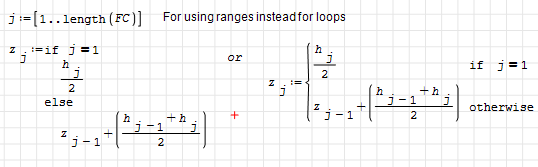
Seismic Site Class & Liquefaction Potential v2.sm (119.62 KiB)已下载 1568 次。
Best regards.
Alvaro.
1页(9条)
- 有新帖
- 无新帖